Show table of contents · 10 sections▾
- 1. The Case Is Too Early
- 2. Liability Is Contested
- 3. Insufficient Damages
- 4. The Defendant Cannot Pay
- 5. Your Attorney Hasn't Filed Yet (and Doesn't Plan To Soon)
- 6. The Case Is Already Heavily Funded
- 7. Your Attorney Won't Engage With Funders
- 8. Documentation Hasn't Reached the Funder
- What Happens After a Denial
- When to Re-Apply Elsewhere
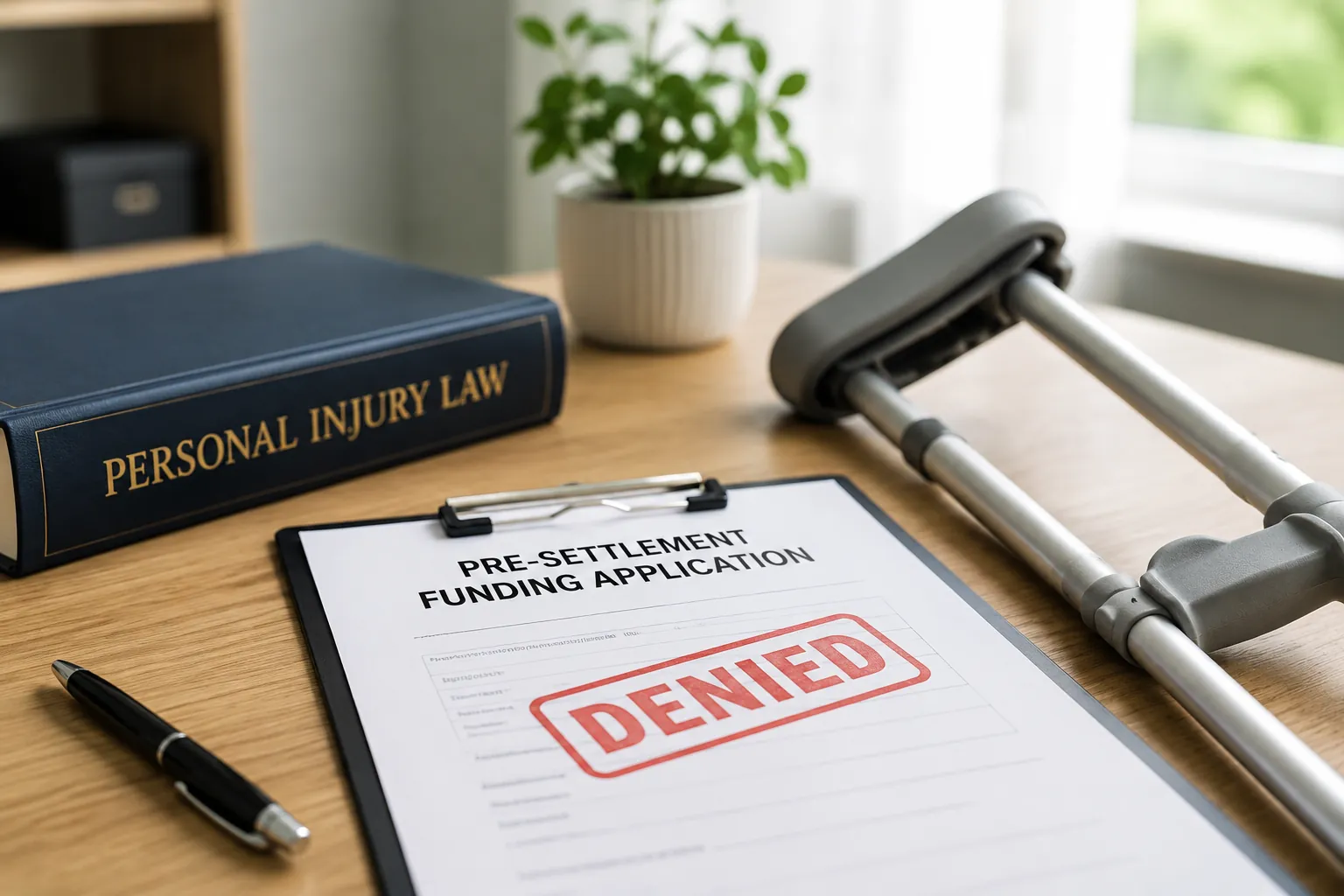
A pre-settlement funding denial can feel like a closed door — especially when bills are piling up and your case is months from settling. The good news is that most denials are not final, and they're rarely about you personally. Funders decline cases for predictable, fixable reasons. Once you understand the eight most common ones, you can either re-apply elsewhere or wait until your case strengthens.
1. The Case Is Too Early
This is the most common reason. Funders need to see at least the contours of liability and damages before they can underwrite. A case that's two weeks old, with no police report attached, no medical records yet, and no demand sent typically doesn't have enough information for any funder to price.
What to do: Wait until your attorney has completed the initial investigation and you have 30–60 days of treatment records. Most cases become fundable around month 2–4 post-injury.
2. Liability Is Contested
Funders avoid cases where the defendant has a real liability defense — comparative negligence, an exculpatory release, or witness contradictions. The riskier liability looks, the less appetite any funder has.
What to do: Ask your attorney where they see liability. If the police report is clean and the defense is reaching, the case may still be fundable at a higher rate. If liability is genuinely disputed, consider waiting for depositions to clarify the picture before re-applying.
3. Insufficient Damages
A clean liability case with $1,500 of medical bills and no lost wages doesn't have enough projected settlement to justify funding. Most funders need to see at least $20,000 of expected case value to make underwriting math work.
What to do: Your case may simply be too small. If your bills grow as treatment continues, re-apply later. If the case is genuinely small, consider waiting for settlement rather than borrowing against it.
4. The Defendant Cannot Pay
A funder won't advance against a settlement that can't be collected. Common dealbreakers: uninsured at-fault driver in a state without robust UM/UIM coverage; defendant in bankruptcy; out-of-state defendant with no recoverable assets; sovereign immunity issues with government defendants.
What to do: Ask your attorney about defendant coverage and asset status. Sometimes additional insurance policies emerge that change the math (e.g., umbrella, employer liability, premises owner). If they do, re-apply.
5. Your Attorney Hasn't Filed Yet (and Doesn't Plan To Soon)
Many funders prefer to fund cases that are either filed in court or about to be. A case that's been pre-suit for 18 months with no demand sent suggests stalled momentum, and stalled cases worry underwriters.
What to do: Talk to your attorney about case progress. If filing is genuinely imminent (within 60 days), most funders will hold the application open. If your attorney is dragging, consider whether case strategy is the underlying issue.
6. The Case Is Already Heavily Funded
If you have an existing pre-settlement advance and the combined liens exceed roughly 15–20% of your expected settlement, additional funders will decline. There has to be enough projected net proceeds to repay everyone and still leave you with a meaningful recovery.
What to do: Pay down your existing balance from another source if possible, or wait until the case settles. Some funders also offer "second-position" advances at higher rates that step behind your existing lien.
7. Your Attorney Won't Engage With Funders
A small minority of attorneys decline to participate in the funding process — typically because they have an ethical concern or had a bad experience with a prior funder. Without your attorney's countersignature, no reputable funder will close.
What to do: Ask your attorney directly whether they will sign a funder's lien acknowledgment. If they decline universally, no funder will approve you regardless of case strength. If they decline only with specific funders, ask which ones they will work with.
8. Documentation Hasn't Reached the Funder
This is the most easily-fixable reason. Funders need pleadings, medical records, the police report, and insurance correspondence to underwrite. If your attorney is slow to send the file, the funder will issue a "pending" status that can feel like a denial.
What to do: Call your attorney's office directly and ask whether the funder's records request has been received and assigned. A polite follow-up usually unsticks the case file within a few days.
What Happens After a Denial
A denial is not a credit event. It does not appear on any credit report. There is no penalty for re-applying — at the same funder or a different one. Plaintiffs are often approved on their second application after one of the following changed:
- Additional medical records arrived that materially increased damages
- Defense made an admission that solidified liability
- Additional insurance policies were identified
- The lawsuit was actually filed
For an overview of the eligibility criteria reputable funders use, see our 2026 eligibility checklist.
When to Re-Apply Elsewhere
If one funder declines your case but you suspect the reasons are surmountable — modest damages, slow attorney, contested but probably winnable liability — get a second opinion from another funder. Different underwriting teams have different risk appetites. We've approved cases that competitors declined the same week.
Frequently asked questions
No. Pre-settlement funding involves no credit check, so denials are not reported anywhere and do not affect credit.
Yes. Most plaintiffs do. Funders expect competing applications.
If facts have changed (new records, defense admission, new policy identified), apply immediately. If nothing has changed, wait 30–60 days for the case to develop.
Yes — and they often can move denials to approvals by providing additional context. Ask your attorney to call the underwriter directly.
That usually means the case has structural issues a higher rate won't fix — disputed liability, no recoverable defendant, or insufficient damages. At that point, the right conversation is with your attorney about case strategy.
Bottom line: Most denials are about the case at this moment, not about you. Understand the reason, fix what's fixable, and re-apply. Apply with Instabridge — even denied cases get a clear explanation of why and what would change the answer.